

Municipal governments face an uphill battle when managing public works fleets and critical infrastructure equipment. On one hand, aging vehicles and outdated machinery threaten service levels. On the other hand, strict capital budget caps and lengthy approval cycles restrict the ability to purchase replacements on time. This tension between immediate operational needs and fiscal constraints is felt daily by city managers and public works directors.
To bridge this gap, municipalities are increasingly turning to rent-to-own programs. This procurement strategy blends the flexibility of short-term rentals with a structured path to full asset ownership. These arrangements allow cities to deploy new equipment immediately, using operational funds, and transition seamlessly to ownership when budgets allow.
This municipal equipment purchasing guide explores the mechanics of municipal rent-to-own programs, the financial and operational benefits for public works, and the impact of state cooperative purchasing regulations on these agreements.
How Municipal Rent-to-Own Programs Function
At the heart of a municipal rent-to-own program is a significant portion of recurring rental payments directly credited toward the final purchase price of the equipment. In the case of some solutions, every dollar municipal governments spend on monthly rentals becomes equity. This strategy provides an unobstructed path to ownership with no sunk costs.
Operational Expenses vs. Capital Expenditures
One of the chief barriers facing municipalities is the traditional split between operating expenses (OpEx) and capital expenditures (CapEx). Rental payments are usually OpEx, which is often more accessible and flexible than CapEx, which typically requires lengthy justification and multistage approvals.
Rent-to-own programs capitalize on this distinction by enabling cities to deploy equipment quickly under their OpEx budget lines. Over time, as the equipment proves essential and funding becomes available, the city can convert the rental into a CapEx purchase without revisiting the procurement process from scratch.
The Difference Between Leasing and Rent-to-Own
It’s important to distinguish rent-to-own programs from equipment leases. Traditional equipment leasing is generally a standard rental agreement. A municipal equipment lease provides equipment in exchange for monthly payments but does not necessarily offer a path to ownership. In some cases, a lease may require a large payment at the end to purchase equipment.
Alternatively, rent-to-own programs are structured around an operational rental, with a built-in equity accrual feature and the option to purchase at a predetermined price. The focus is on flexibility and operational assurance rather than just renting.
Strategic Benefits of Rent-to-Own for Public Works
For public works departments, whose mission-critical equipment underpins everything from sanitation to emergency response, the rent-to-own model offers several unique strategic advantages:
- Operational verification: These programs reduce risk by allowing municipalities to try before they buy. For example, a municipality looking to purchase a sewer truck could use these programs to determine whether a specific vehicle can maneuver tight city streets before investing hundreds of thousands of dollars. Rent-to-own programs allow teams to validate heavy equipment in real-world conditions for several months, enabling operators to assess performance, maintenance needs and true fit to reduce the likelihood of expensive mistakes.
- Immediate deployment: Equipment failure doesn’t wait for budget cycles. If a street sweeper or snowplow goes down midseason, waiting for a new budget year is not an option. Rent-to-own programs enable immediate deployment of essential machinery, sometimes within days, ensuring services continue without disruption. At the end of the season or fiscal year, municipalities can choose whether to return, swap or purchase the equipment, converting all eligible rental payments into equity.
- Budgetary fluidity: Municipality revenue is often subject to the fluctuations of economic cycles, grant schedules and tax collection rates. Rent-to-own agreements offer budgetary agility, allowing a city to spread the cost of buying vital equipment across operational budgets or tie major purchases to the arrival of grant funding, without locking itself into premature commitments.
High-Value Equipment Ideal for Rent-to-Own Agreements
Many public works projects require specialized, high-performance machinery. Selecting the right equipment is crucial, and rent-to-own agreements offer a practical approach for municipalities managing specialized or mission-critical fleet needs. Some high-value equipment to consider includes:
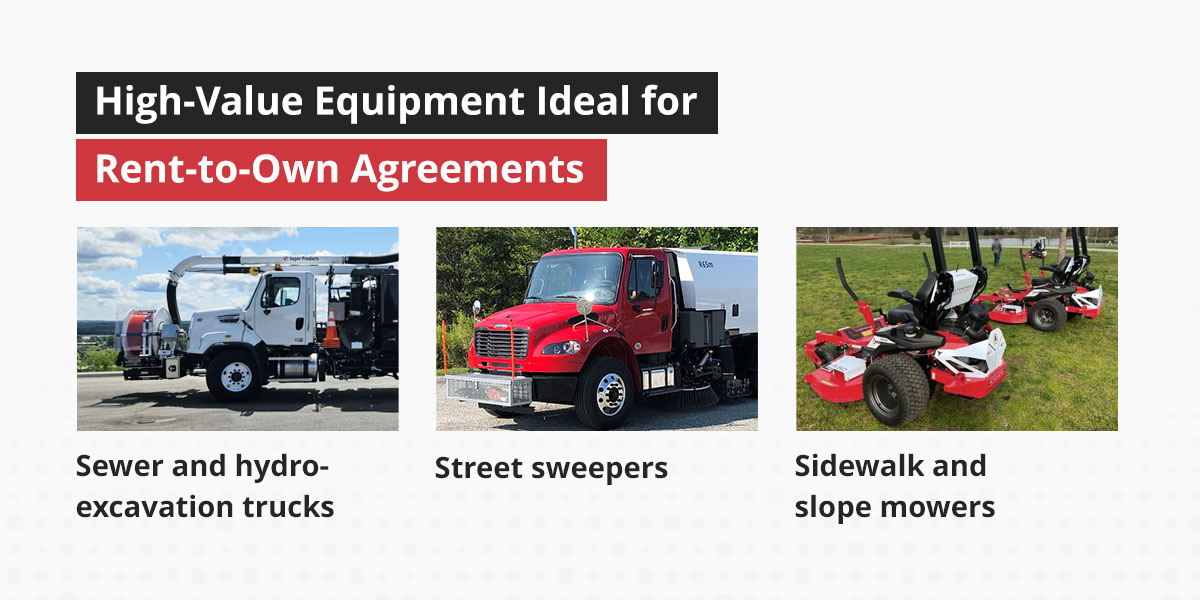
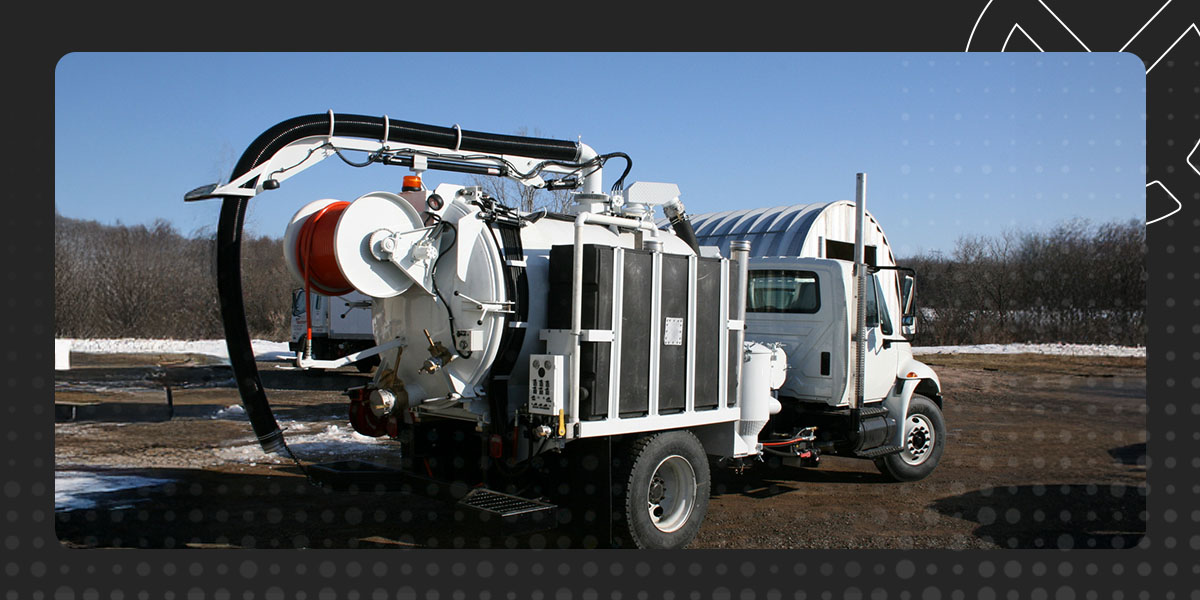
- Sewer and hydro-excavation trucks: Complex, high-maintenance equipment like sewer and hydro-excavation trucks comes with a high price tag and an even steeper risk of missed specifications. Teams must confirm key elements such as tank volume, water pressure, hose length and maneuverability in each context. Rent-to-own programs enable extended, risk-free field testing, ensuring that every feature pays off in real-world operations.
- Street sweepers: Different cities face varying street-surface types, debris loads and legislative requirements, such as stormwater abatement. These programs enable cities to try different sweeper technologies, such as regenerative air or mechanical broom systems, on actual roads, measured by local metrics. This test-drive can expose hidden costs or performance limitations before committing capital funds.
- Sidewalk and slope mowers:Specialty mowers for sidewalks, right-of-way and embankments often face tough ergonomic and safety requirements. Rent-to-own programs enable operators and safety officials to evaluate features like operator comfort, sightlines and safety cut-offs. If the equipment passes all necessary tests, the municipality can proceed with the purchase without buyer’s remorse or operator resistance.
Navigating State Purchasing Regulations
Procurement regulations for municipal equipment are complex and vary by state. Generally, the rent now, own later model aligns with cooperative purchasing frameworks and competitive bidding requirements. Here’s what you’ll need to understand before investing in equipment:
- Cooperative purchasing alignment: Most states offer a cooperative purchasing program to enable municipalities to rely on prenegotiated equipment contracts. Rent-to-own agreements can leverage these frameworks, using state-approved pricing and contract terms to streamline acquisition and ensure compliance.
- Bidding requirements: Initial rent-to-own rates are usually based on an established contract. Establishing these terms can reduce or eliminate the time-consuming public bidding process, shaving months off procurement cycles and allowing rapid deployment in times of operational urgency.
- Compliance and transparency: Teams document each payment and the resulting equity build through clear, auditable paper trails. Municipal finance officers and auditors can easily ensure contract compliance and monitor budget impact, improving both transparency and community trust. With contracts outlining rental terms and final purchase options, there is minimal risk of confusion or noncompliance.
The MTech Difference: Elevating the Ownership Journey
Purchasing heavy equipment is a significant investment, and finding the right partner to support your equipment finance plan makes all the difference. At MTech, our team is committed to providing comprehensive solutions to meet diverse customer needs. Our rent-to-own program enables customers to test equipment before committing to a purchase. Unlike a traditional lease, our rent-to-own program includes 24/7 support and on-site maintenance during your rental period to remove downtime risks.
We also have dedicated teams to support cities across Ohio, Michigan and Pennsylvania. Our regional expertise enables us to alleviate your administrative burden and ensure a seamless acquisition and timely deployment. We leverage in-depth familiarity with local statutes and cooperative purchasing rules to navigate the paperwork while ensuring compliance.
Discuss Rent-to-Own Inventory With MTech
Rent-to-own equipment programs offer municipalities a strategic, flexible pathway to equipment ownership that accommodates budgeting cycles, operational realities and regulatory compliance. For city managers and public works directors seeking innovation under constraint, the rent-to-own model represents a smarter, faster and safer route to fleet modernization and community service excellence.
When you choose MTech for rent-to-own programs, you create a lasting partnership with a business that will help you find exactly the right equipment. We’re here to elevate your results. Request a consultation to discuss active rent-to-own inventory or specific state contract eligibility.